Callback Functions and Higher-Order Functions

Hello! This article is a follow up with my series JavaScript: The Hard Parts v2 Cover from a course I took from Frontend Masters By Will Sentance.
Before we move into Callbacks and Higher-Order Functions, let's know what a Function is all about first.
Why do we really need Functions?
Firstly, a Function is just a block of code that performs a particular task when invoked and is stored in memory to be used as many times as needed, preventing replication of similar code.
To really understand why we need functions, lets look at these examples below:
Example 1:
function add9to9() {
  return 9 + 9
}

add9to9()  // 18
Example 2:
function add5to5() {
  return 5 + 5
}

add9to9()  // 10
Both functions above are basically returning the addition of the same numbers but both numbers are specific to their function. And that's not really productive since Functions are to help us not repeat ourselves.
Example 3:
function addSameNum(num) {
  return num + num
}

addSameNum(4) // 8
Looking at the example above, the function addSameNum is taking an argument value 4 and returning the sum of the value passed to the parameter num. Doing this makes a big difference because we don't have to write separate functions to perform similar tasks, instead just one.
Parameters (placeholders) are named variable, (from the example above
numis the parameter) stored in memory and isn't assigned a value until the function is invoked and passed an argument value.Arguments are values passed into a
functionparameter when invoked.
From Example 1 and 2, the Function body is basically doing the same thing with different literal values, and it breaks the Principle DRY - Don't Repeat Yourself.
So that's why Example 3 is a much better approach, but wait a sec, is it the best approach, what if I'll like to add two different values, and also, would like to multiply these values and also add the values if needed.
Interesting right, how can we write one function to do all those instructions above when invoked? That's where Callback Functions comes into play.
Here some guidelines you should note about Callback Functons.
There's a saying Functions are first class citizens / objects. Meaning function are basically Objects and can do what Objects can do.
- Functions can be assigned to variables and properties of other objects.
- Functions can be passed as arguments into functions.
- Functions can be returned as values from functions.
Callback Functions
Callback Functions are function(s) inserted into another Function. Example:
[1,3].forEach(callbackFunction)

const callbackFunction = (item) => {
   console.log(item)
}
From the example above, the function named callbackFunction is a Callback Function, which was invoked inside the function forEach making it an Higer-Order Function.
Higher Order Functions
Higher Order Functions are Functions that takes in a function as parameter values or returns a function.
Now that we know what Callback and Higher Order Function are, let's look into Examples to explain the terms.
Here is a function below, which makes Example 1 and 2 even more reusable:
Example 4
function doOperation(input1, input2, instruction) {
  return instruction(input1,input2)
}

function add(val1,val2) {
  return val1 + val2;
}

function multiply(val1,val2) {
  return val1 * val2;
}

doOperation(2,3,add)       // 5

doOperation(2,3,multiply)  // 6
Wow! The first function: doOperation looks daunting right? Allow me to simplify it by showing how Javascript reads the instruction.
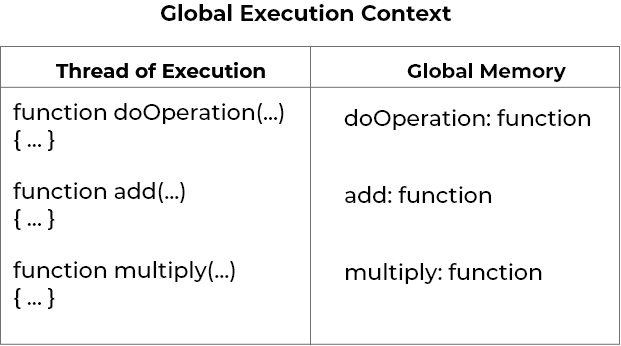
From the illustration above, the functions are stored in the Global Memory.
Note: Javascript doesn't know what's in the function body yet, until it's invoked.
Execution Context has been discussed here.
On calling doOperation(2,3,add) a Function Execution Context is created and doOperation() is added to the Call Stack
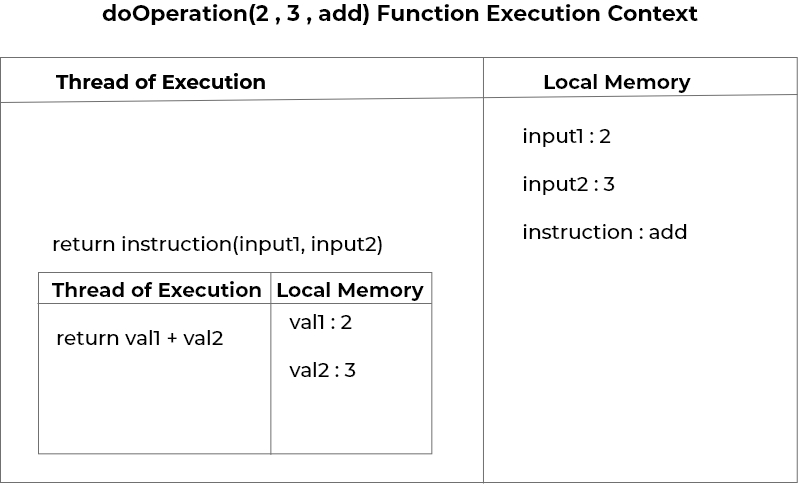
The parameters hold the values passed as arguments, which are 2,3,add and stored in the Local Memory for the function.
Inside doOperation(2,3,add) function body, instruction has the value add and the function is to return instruction(input1, input2). Javascript has look for the value passed to instruction because it's just a placeholder in memory.
Since the value is add, we could replace instruction(input1, input2) to add(input1, input2). But remember input1 and input2 are also placeholders and have been assigned values.
So, it could be written as return add(2,3), which was return instruction(input1, input2). Now, Javascript checks the Local Memory of doOperation() if add function exist and it doesn't. Then, it moves to the Global Memory, which does have add function.
Since add function exist (add: function) in the Global Memory, it's then invoked, whereby creating a Function Execution Context and added to the Call Stack.
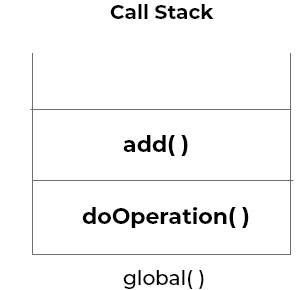
val1, val2as parameters in theaddfunction are replaced with the values ofinput1, input2.
When the returned value is got from add function which will be 5 in this case, the add() Function Execution Context is deleted, also in the Call Stack.
Then, the returned value is passed to the doOperation function as it's returned value.
That's a lot to comprehend, right? All that Javascript does behind the scene. I've got to say these concepts are pretty much difficult to grasp.
Mind you, there are a lot of applications to Callback Functions and Higher-Order Functions, but I'll stop here.
Hey! it's time for a quiz 😁, after going through all these, could you tell which function is the Callback Function or Higher Order Function?
- doOperation() is the Callback Function
- add() is the Higher Order Function
- doOperation() is the Higher Order Function
- add() is the Callback Function
Comment below, I'll love to know your answers.
Hint: there are two answers
For more understanding on Higher-Order Function, I'll suggest you read a blog by @omotola
Thanks for reading.
About the author
- I'm Favourite Jome, a Software Engineer focused on building reliable systems, great developer tooling, and seamless user experiences.
Comments
Join the discussiondoOperation() is the Higher Order Function as it returns a function :) and add() is the Callback Function as it is called back
Thanks Jome , great content
Correct Kishore, thanks for the reply
JavaScript: The Hard Parts v2 - Cover.
I'm sharing what I've learnt from a course I took: "JavaScript: The Hard Parts v2" from [Frontend Masters](https://frontendmasters.com/courses/javascript-hard-parts-v2/) by Will Sentance.


